Choose Cameras Around the Footage You Need
A single motorcycle camera rarely excels at both cinematic pass-by video and zero-maintenance traffic incident logging. Before buying adhesive chin brackets or routing coax cables under your fuel tank, separate your requirements into three distinct hardware categories: battery-powered POV action cameras, 360-degree reframing cameras, and hardwired dual-channel dash cameras.
Helmet & Bar Action Cameras: Stabilization at the Cost of Battery Management
Modern action cameras such as the GoPro Hero12 Black, DJI Osmo Action 4, and Insta360 Ace Pro use 1/1.9-inch to 1/1.3-inch CMOS sensors paired with aggressive electronic image stabilization (HyperSmooth, RockSteady, FlowState). Mounted to a helmet chin bar, they record exactly where the rider looks and isolate chassis vibrations naturally through the rider's neck and torso.
The practical limitation is power and mass. At 4K/60fps, a 1720 mAh to 1950 mAh lithium-ion cell typically runs for 65 to 95 minutes in mild temperatures according to manufacturer specification sheets, and less in cold mountain air or when high-bitrate modes are active. Running a USB-C power cable to a helmet creates a snag hazard, while running USB-C power to a handlebar-mounted action camera requires opening or replacing the waterproof battery door—reducing the published IP68 rating to splash resistance at best.
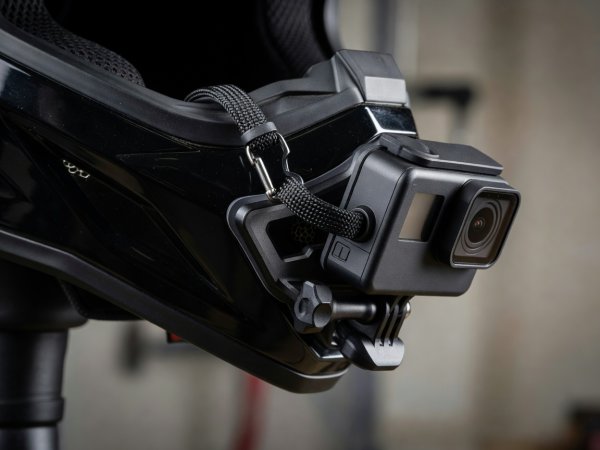
POV Action Camera Fitment Checklist
- Helmet Chin GeometryRequires 45 mm x 35 mm flat or uniform curve
- Adhesive Cure Time3M VHB 4991 tape needs 24 hr cure at >15°C
- Helmet Weight Penalty145 g–180 g camera + 45 g mount arms
- Regulatory NoteCheck local ECE 22.06 shell attachment rules
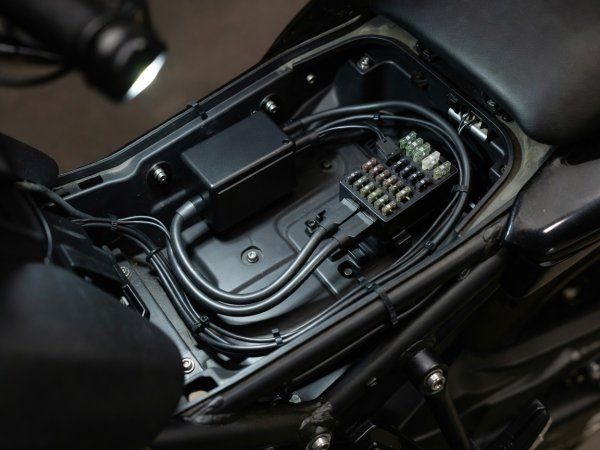
Hardwired DVR Wiring Checklist
- Red Wire (B+)Fused permanent 12V for file-close capacitor/save
- Yellow Wire (ACC)Switched 12V trigger (tail light or aux port)
- Black Wire (GND)Clean unpainted chassis bolt or battery negative
- Loop Interval1-minute or 3-minute TS/MP4 segment files
Set-and-Forget Incident Recorders: Innovv, Viofo & Nextbase Architectures
If your primary goal is insurance documentation during daily commuting or multi-week touring, a removable action camera fails the moment you forget to charge it. Hardwired motorcycle dash camera systems (such as the Innovv K5 or K6, Viofo MT1, and Chigee integrated camera kits) split the hardware into two compact IP67-rated bullet lenses and a central DVR box stored under the seat.
When wired to a switched 12V accessory circuit, the DVR boots automatically within seconds of turning the ignition key and records continuous front and rear loop footage. Look for systems specifying supercapacitors rather than internal lithium pouch batteries inside the under-seat DVR; supercapacitors tolerate high under-seat heat above exhaust headers without swelling and hold just enough charge to close the final video file cleanly when the key is turned off.
Published Camera Specifications vs. Mounting Reality
The table below compiles published manufacturer specifications alongside practical installation constraints riders encounter on real motorcycles. Where a specification varies by firmware or optional accessory, we note the condition explicitly.
| Model & Type | Sensor & Max Resolution (Sourced) | Body Mass (With Battery) | Weather Sealing (Published) | Continuous Power & Mounting Notes (Editorial Assessment) |
|---|---|---|---|---|
| GoPro Hero12 Black POV Action |
1/1.9" CMOS; 5.3K60 / 4K120 | 154 g | 10 m (33 ft) with standard door latched | Requires optional Contacto magnetic door or pass-through door for 5V ride power; integrated 1/4-20 threads + folding fingers. |
| DJI Osmo Action 4 POV Action |
1/1.3" CMOS; 4K120 | 145 g | 18 m (IP68 equivalent, door closed) | Magnetic quick-release latch speeds removal at fuel stops; requires 3.5 mm USB-C audio adapter for helmet mic. |
| Insta360 X4 360 Dual-Lens |
Dual 1/2" CMOS; 8K30 / 5.7K60 360° | 203 g | 10 m (IPX8, doors sealed) | Heavy lever-arm torque on extension poles; requires double-clamp U-bolt stabilization on crash bars to prevent metal fatigue. |
| Innovv K5 Dual-Channel Dashcam |
Front 4K30 (Sony sensor) + Rear 1080p30 | Front cam incorporates DVR; remote rear cam | IP67 rated cameras & connectors | Hardwired 12V-to-5V converter; front unit is larger than bullet cams (requires beak or headlight cowl clearance). |
| Viofo MT1 Dual-Channel Dashcam |
Dual 1080p30 (Sony STARVIS IMX291) | Under-seat DVR + 32 g bullet lenses | IP66 rating across DVR & lenses | Uses supercapacitor in DVR; lower resolution than 4K action cams, but compact lenses hide easily under tail tidy and front triple tree. |
Installation Considerations Before You Drill or Stick
Front Fork vs. Upper Fairing Camera Placement
Never mount a camera on the unsprung lower fork leg without verifying full suspension compression clearance against the upper fender and radiator guard. Unsprung fork legs experience severe vertical shock over potholes. Mounting the front dashcam lens to the sprung upper triple clamp or beneath the headlight beak keeps the lens isolated by the front suspension and preserves cable Slack across full steering lock.
360-Degree Extension Poles and Clamp Shear Stress
A 200-gram 360 camera extended 100 cm behind a tail rack acts as a weighted pendulum. Single-point ball mounts frequently slip or snap at the aluminum neck under bumpy road loads. Always use a dual-point support brace (clamping both the base and mid-section of the pole to pillion grab rails or pannier frames) and attach a secondary braided steel safety lanyard.
MicroSD Card Wear in Loop Recording
Standard consumer microSD cards use TLC NAND flash optimized for occasional photo bursts and can lock into read-only failure after a few hundred full overwrite cycles in a motorcycle dashcam. Specify cards explicitly labeled "High Endurance" or "Max Endurance" (rated U3 / V30) and format the card inside the camera menu every 60 days.