Match Navigation and Mounts to Your Cockpit
Where you place your navigation screen dictates how far your eyes drop from the road and whether your tank bag blocks your view at tight intersections. Riders today choose between three distinct hardware setups: rugged standalone GPS navigators, hardwired Apple CarPlay / Android Auto external displays, and mechanically isolated smartphone mounts.
Offline Satellite Reliability vs. App Flexibility
Dedicated motorcycle navigators such as the Garmin Zumo XT2 or TomTom Rider 550 store multi-region topographic and street maps directly in onboard memory. They do not depend on cellular towers, smartphone battery state, or Wi-Fi projection handshakes, and their pogo-pin cradles lock mechanically to AMPS 4-hole base plates (30 mm x 38 mm hole spacing).
Conversely, hardwired wireless CarPlay and Android Auto screens (such as the Chigee AIO-5 Play/Lite or Carpuride W502/W702) act as rugged weatherproof external monitors for the phone in your jacket pocket. You keep familiar routing apps (OsmAnd, Rever, Calimoto, Google Maps) on a bright 5-inch to 7-inch cockpit screen while isolating your phone's delicate camera sensors from handlebar shock. The trade-off: continuous wireless projection draws roughly 15% to 25% of your phone's battery per hour unless the phone is plugged into a jacket-pocket power bank or tank-bag USB lead.
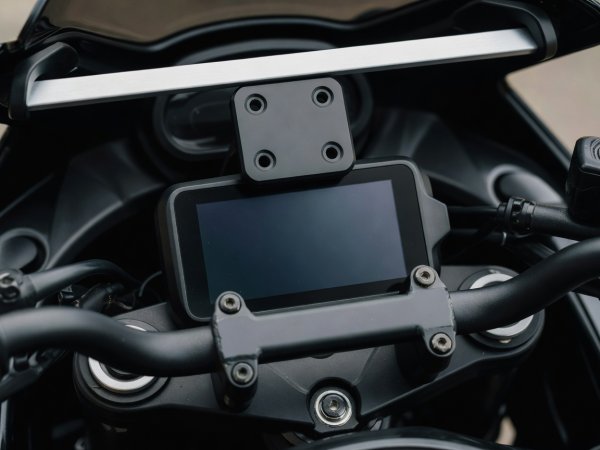
Cockpit Mounting Standards
- AMPS Hole Pattern30 mm x 38 mm rectangular M4 bolt spacing
- RAM B-Size Ball1-inch (25.4 mm) elastomeric ball rated up to 900 g
- Rally Crossbar12 mm (BMW/KTM/Yamaha) or 16 mm/22 mm diameter
- Fork Stem Bore12 mm–24 mm internal expansion plug for clip-ons
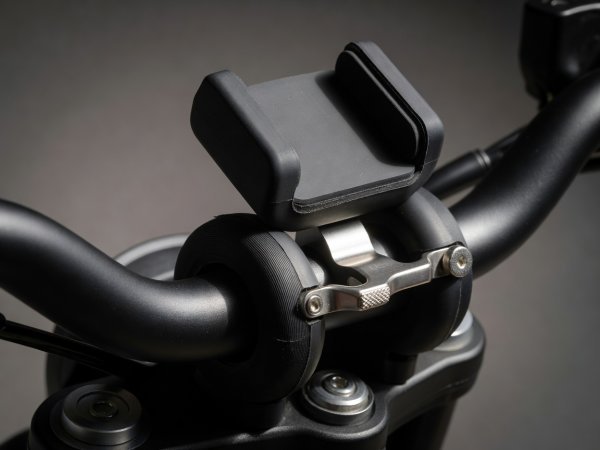
Smartphone Mount Survival Rules
- Vibration IsolatorMandatory elastomer stage for OIS/autofocus phones
- Rain Touch BehaviorCapacitive screens register false taps in heavy rain
- Thermal CeilingDirect sun + wireless Qi charging triggers dim-out
- Ignition Key AccessCheck portrait/landscape sweep over key barrel
Why Elastomer Dampeners Reduce—But Cannot Eliminate—Camera Risk
Motorcycle manufacturers and smartphone makers alike explicitly warn that high-amplitude engine vibrations can degrade closed-loop Optical Image Stabilization (OIS) gyroscopes and voice-coil actuators. Mounting hardware brands including Quad Lock, Peak Design (SlimLink), and SP Connect engineered silicone and elastomer suspension modules designed to attenuate high-frequency chassis buzz (typically above 100 Hz).
While an elastomer dampener dramatically reduces high-frequency transmission compared to a solid metal clamp, riders on high-vibration single-cylinder thumpers, rigid-mount V-twins, or washboard gravel tracks should still consider keeping their primary daily-use smartphone off the handlebars—using either an older secondary phone without OIS or a hardwired CarPlay/GPS unit.
Navigation & Mounting Hardware Comparison
| Hardware Option | Display / Retention Type | Power Requirement | Published IP Rating | Cockpit Fitment & Control Limitations |
|---|---|---|---|---|
| Garmin Zumo XT2 Standalone GPS |
6.0" glove-friendly transmissive TFT (1050 nits) | Hardwired 12V-to-5V pogo-pin cradle | IPX7 waterproof | AMPS 4-hole cradle; large footprint (156 x 89 x 25 mm) can crowd compact naked-bike bars. |
| Chigee AIO-5 Lite / Play CarPlay / Android Auto |
5.0" IPS high-brightness screen (1000–1200 nits) | Hardwired 12V switched harness | IP67 / IP68 rated | Compact 5-inch chassis fits tight cockpits; relies on smartphone battery & cellular/offline app cache. |
| Quad Lock PRO + Dampener Modular Phone Mount |
Dual-stage twist lock + silicone grommet dampener | Optional 12V or USB Weatherproof Wireless Head | Mount mechanical; Qi head IP66 | Fits 22.2, 25.4, 28.6, 32, and 35 mm bars; requires model-specific polycarbonate phone case. |
| Peak Design Motorcycle Bar Mount SlimLink Magnetic/Mechanical |
Zirconia ceramic locking jaws + integrated EPDM isolator | Optional Qi2 wireless charging head | Anodized aluminum + weatherproof Qi head | Built-in vibration isolator reduces stack height compared to add-on dampener pucks. |
| RAM X-Grip (RAM-B-149Z-UN7U) Universal Spring Cradle |
Spring-loaded 4-finger elastomer grip + tether | None integrated (use separate USB port) | Marine-grade aluminum / stainless steel | Accepts almost any cased phone, but has no tuned high-frequency OIS isolator stage and can press side volume buttons. |
Cockpit Installation Considerations
Above-Cluster Rally Bar vs. Handlebar Riser Placement
Mounting a screen on a 12 mm rally bar directly above the OEM speedometer keeps the display in your peripheral line of sight so your chin stays up. However, tall 6-inch GPS units mounted on thin sheet-metal windshield brackets can oscillate on rough pavement. If your windscreen bracket flexes under hand pressure, add lateral reinforcement struts or move the mount down to the rigid forged handlebar riser clamp.
Clip-On Sportbike Fork Stem Clearances
Sportbikes with clip-on handlebars rarely have exposed round bar tubing. A hollow-bore fork stem mount expands inside the central steering stem nut (typically 12 mm to 24 mm I.D.). Before buying a stem mount, verify that your steering stem nut is not solid-capped and check that the mounted screen does not hit the inside of the windshield bubble at full left or right steering lock.
Glove Touch Screens and Rain Lock Modes
Standard capacitive screens rely on electrostatic distortion, which means heavy raindrops pooling on a horizontally angled phone screen can trigger phantom zooms or cancel routes. Look for navigation devices with a physical hardware "Screen Lock" button or handlebar controller integration (such as BMW Wonder Wheel or Garmin Handlebar Controller) so you can disable touch input during downpours.