Plan Power for the Devices You Carry
Adding a GPS cradle, a USB-C charger, and a dual-channel dashcam one weekend at a time often leaves three pairs of ring terminals stacked awkwardly on a tiny M6 battery bolt—and a motorcycle that clicks dead after ten days in the shed. Planning your 12V architecture around stator capacity, switched ignition triggers, and weather-sealed connectors prevents both parasitic drain and roadside fuse failures.
Why 12V-to-5V Transformers Must Never Sit Unswitched on the Battery
A motorcycle AGM or lithium (LiFePO4) starter battery typically holds only 8 Ah to 14 Ah of capacity—roughly one-fifth of a compact car battery. Every USB port, wireless Qi charging head, GPS cradle, and dashcam power supply contains an active DC-DC buck converter that steps 12V–14.4V down to 5V or 9V. Even when no phone or GPS screen is attached, that buck converter draws continuous quiescent current.
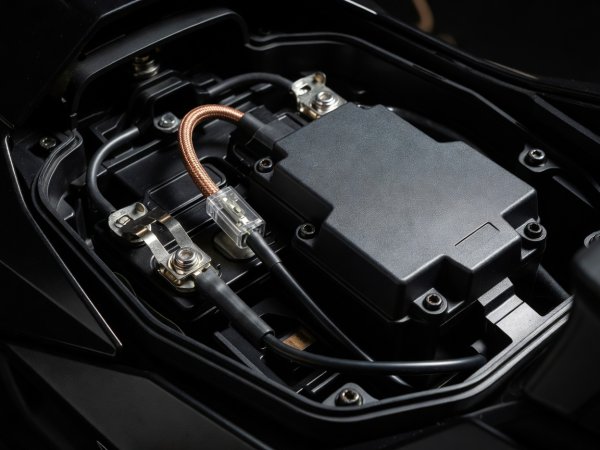
Only a plain passive SAE battery tender pigtail (with an inline 7.5A or 10A blade fuse) should connect directly to the battery posts. Every active voltage converter should be switched off with the key using either the motorcycle's factory switched auxiliary plug, a 30A automotive relay triggered by a tail-light lead, or a solid-state power distribution module.
Stator & Load Budgeting
- USB-C PD Fast Charger18W – 30W (1.5A – 2.5A @ 12V)
- GPS / CarPlay Display8W – 15W (0.7A – 1.2A @ 12V)
- Dual-Channel Dashcam6W – 10W (0.5A – 0.8A @ 12V)
- Heated Grips + Jacket35W + 65W (check stator headroom on <400cc bikes)
Connector Standards Explained
- SAE 2-Pin PolarityExposed pin on battery side MUST be negative (GND)
- DIN Hella (ISO 4165)12 mm diameter; tighter vibration lock than 21 mm cigar
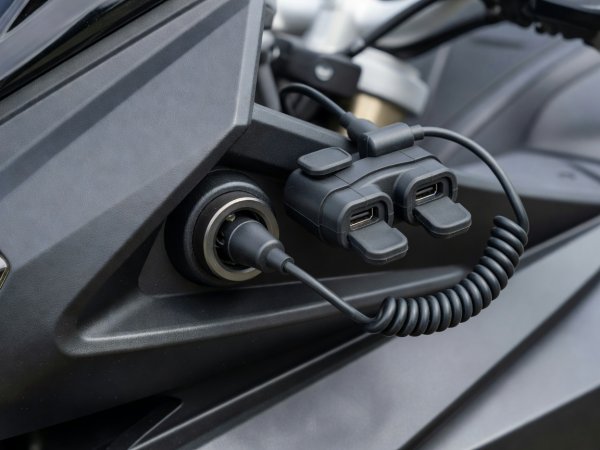
- USB-C Power DeliveryNegotiates 5V, 9V, or 12V PDO; water shorts open pins
- CAN-Bus Aux PortOften software-limited to 5A (60W) before tripping
SAE, DIN ISO 4165, and Solid-State Power Hubs
Standard automotive 21 mm cigarette lighter sockets fail quickly on motorcycles because road shock vibrates the spring-loaded center pin loose, causing momentary arcing and reset loops. European touring motorcycles (BMW, Triumph, Ducati, KTM) frequently fit the smaller 12 mm DIN Hella (ISO 4165) socket, whose internal detent clips hold an adapter firmly over rough pavement.
When wiring multiple accessories, avoid vampire taps (Scotch-locks) that sever copper strands in factory wiring harnesses. Instead, install a compact solid-state hub—such as a HealTech ThunderBox (which senses alternator charging ripple above 13.5V to switch circuits on automatically) or a CAN-bus controller (Hex ezCAN or Denali CANsmart)—so all accessory grounds and fused positives land on one protected terminal block.
Motorcycle Power & Charging Hardware Comparison
| Accessory Type | Input / Output Rating | Switch Trigger Method | Weather Protection | Installation & Compatibility Notes |
|---|---|---|---|---|
| SAE-to-USB-C PD Dongle OptiMate O-108 / O-118 |
12V DC in; 5V/3A, 9V/2A (18W USB-C) out | Built-in voltage cutoff (<12.3V shuts off) | Weatherproof cap & inline seal sleeve | Verify cutoff voltage if using a LiFePO4 battery (which rests at ~13.2V and may keep voltage-sense dongles awake). |
| DIN ISO 4165 Dual USB Adapter Low-Profile Angled Plug |
12V–24V DC in; USB-A QC3.0 + USB-C PD 30W | Controlled by bike's OEM DIN socket timer | Rubber flap over ports when unplugged | Zero wiring required; unplug during heavy rain as water wicked along a USB cord can corrode open 5V/9V pins. |
| HealTech ThunderBox (TB-U01) Voltage-Sense Power Hub |
Up to 16A total load (4x 4A tool-free terminals) | Automatic engine-run voltage ripple sense + optional white trigger wire | IP67 potted epoxy module | Ideal when you cannot find a switched 12V wire; includes short-circuit and overload self-resetting protection. |
| Hex ezCAN / Denali CANsmart CAN-Bus Accessory Manager |
4 programmable circuits (up to 10A–25A configurable) | Reads motorcycle CAN-bus ignition & switch signals | Sealed automotive diagnostic plugs | Model-specific harness required (BMW, KTM, Harley, Yamaha, Honda); lets you set electronic fuse limits via PC/Mac software. |
| Quad Lock / Peak Design 12V Wireless Head Hardwired Qi / Qi2 Charger |
12V–24V DC input; 5W/7.5W/10W/15W inductive out | Auto-standby or ignition-switched mode | IP66 / IP67 sealed coil housing | Eliminates exposed USB port corrosion in rain; generates more heat inside phone case than wired USB-C charging. |
Electrical Installation Considerations
Checking SAE Polarity Before Plugging In
While the standard SAE 2-pin connector wires the shrouded female socket on the battery lead to positive (+12V) and the exposed male pin to ground (-), adding an inline SAE extension cable or a solar adapter can reverse polarity if not checked. Always test your SAE outlet with a digital multimeter before plugging in a USB adapter or GPS converter.
Why You Should Unplug USB-C Cables in Heavy Rain
Panel-mount USB sockets are only IP65 or IP66 rated when their rubber dust cap is pressed firmly shut. Once you insert a USB-C cable on the handlebar, rainwater running down the cable jacket can wick into the 24-pin receptacle. Electrolytic corrosion across 9V or 12V USB-C PD pins can trip the charger or damage your phone's charging port within minutes. In torrential rain, unplug the USB cord, seal the rubber cap, and rely on your device's internal battery or a sealed inductive/pogo-pin mount.
Routing Wires Past the Steering Head Without Pinching
Every wire running from an under-seat power hub to the handlebars flexes thousands of times over the life of the bike. Follow the factory clutch cable or main loom path around the steering head neck, encase 16–18 AWG wires in split braided PET sleeve, and verify with the front wheel off the ground that turning the bars from hard left stop to hard right stop places zero tension on the cable ties.